Promotional graphic showing a luxury Newport Beach oceanfront home at sunset with text explaining how the Garn–St. Germain Act may allow homeowners to transfer a low mortgage rate to their children, featuring the Lucas Real Estate logo.

The Garn–St. Germain Act: How a Little-Known Federal Law May Let You Transfer Your Ultra-Low Mortgage Rate to Your Children

  • January 14, 2026
  • devinlucas

Many Newport Beach and Costa Mesa homeowners are sitting on historically low mortgage rates—and don’t realize a federal law may allow them to transfer property, and their low mortgage, to their children without triggering a refinance. The Garn–St. Germain Act of 1982 can protect certain family transfers, but only when done correctly. In this article, we break down what the law allows, where it doesn’t apply, and how local families are using it as part of smart real estate, tax, and estate planning.

Informational graphic with a blurred apartment interior background. White text reads: 'What Happens When a Tenant Moves Out Early? A Landlord’s Guide in California' followed by bullet points: Tenant Responsibility, Landlord’s Responsibility to Re-Rent the Rental Unit, What If the Tenant Finds a Replacement?, and What Landlords Can (and Should) Do. The Lucas Real Estate Group logo is centered at the bottom.

When Are Sellers Exempt From Certain Disclosures in California Real Estate?

  • August 25, 2025
  • devinlucas

California law requires real estate sellers to disclose known material facts about their property, even when certain exemptions apply. While some sellers—like trustees, fiduciaries, or those involved in court-ordered sales—may be exempt from completing forms such as the Transfer Disclosure Statement (TDS), they are still obligated to disclose any defects that could impact the property’s value. Learn how exemptions work, when they apply, and why tools like the Exempt Seller Disclosure Form are essential for compliance. For trustees, explore our detailed guide to their specific disclosure requirements. Whether you’re selling in Newport Beach, Costa Mesa, or other coastal Orange County communities, Lucas Real Estate ensures your transaction is smooth, compliant, and stress-free.

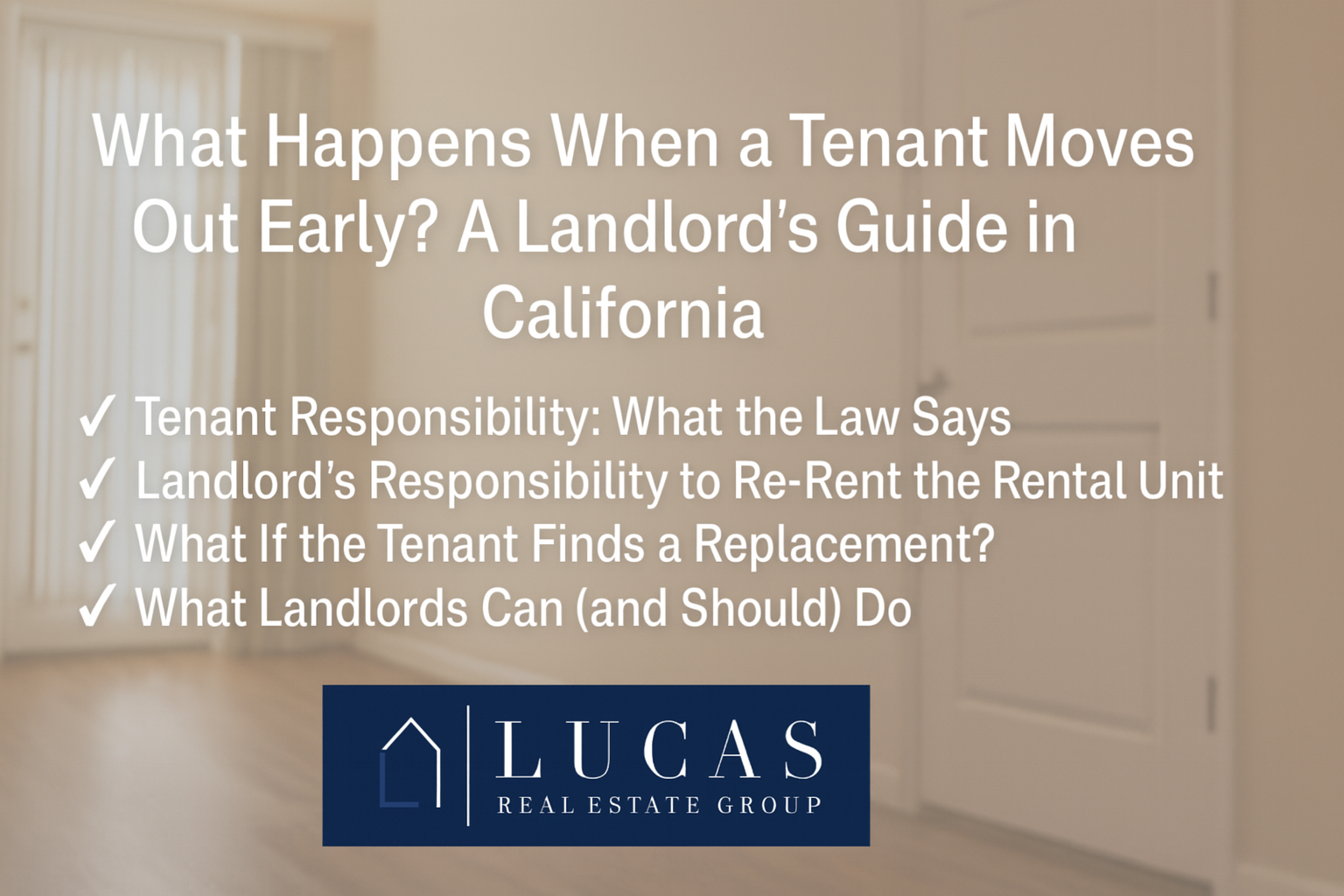
Informational graphic titled 'What Happens When a Tenant Moves Out Early? A Landlord’s Guide in California' with a blurred apartment interior in the background. The text highlights key topics: Tenant Responsibility, Landlord’s Responsibility to Re-Rent, What If the Tenant Finds a Replacement, and What Landlords Can (and Should) Do. The Lucas Real Estate Group logo is centered at the bottom.

What Happens When a Tenant Moves Out Early? A Landlord’s Guide in California

  • August 25, 2025
  • devinlucas

What happens when a tenant moves out before their lease ends? In California, tenants remain responsible for unpaid rent and re-rental costs—but landlords must make reasonable efforts to find a replacement rather than simply charging the tenant for the full lease term. Under California Civil Code § 1951.2, landlords have a legal duty to mitigate damages by advertising the property, setting a fair market rent, and considering qualified replacement tenants. If a landlord rejects a viable tenant without good reason, the outgoing tenant’s liability may be reduced. A proactive approach can minimize downtime and financial loss for both parties.

Promotional graphic for Lucas Real Estate Group featuring the headline “Navigating California’s ‘Mansion Tax’” centered above the Lucas Real Estate Group logo, set against a background image of a luxury Mediterranean-style estate at dusk.

The So-Called “Mansion Tax” — How It Negatively Impacts Real Estate

  • July 14, 2025
  • devinlucas

Los Angeles’ so-called “Mansion Tax” isn’t just a L.A. problem—it’s a warning shot for property owners across Orange County. Branded as a luxury tax, Measure ULA has stalled high-value transactions, slashed property tax revenues, and deterred housing development. As similar ideas loom statewide, Newport Beach and Costa Mesa property owners, investors, and trustees need to stay informed—and protected.

Promotional graphic for Lucas Real Estate Group featuring a luxury coastal-style home in the background with the text: “Don’t leave a deceased parent’s home in their trust to ‘avoid’ property tax reassessment.” The Lucas Real Estate Group logo is centered at the bottom. The design is professional, with a soft overlay for text clarity and ample spacing around the edges.

Why You Shouldn’t Leave a Deceased Parent’s Home in Their Trust to “Avoid” Property Tax Reassessment

  • July 14, 2025
  • devinlucas

Thinking of keeping a deceased parent’s home in their trust to “avoid” reassessment? Don’t do it. This common myth can lead to massive tax bills, penalties, title issues, and even trustee liability. At Lucas Real Estate Group, we help clients across Newport Beach, Costa Mesa, and Orange County navigate property transfers, Proposition 19, and trust administration — the right way.

Elegant real estate. Overlaid text reads: ‘The Big Beautiful Bill’s Impact on Real Estate,’ with the Lucas Real Estate Group logo centered below — a professional, high-end promotional graphic.

What the 2025 Federal Tax Reform Means for Homeowners (aka The Big Beautiful Bill’s Impact on Real Estate)

  • July 14, 2025
  • devinlucas

The 2025 federal tax reform delivers major wins for homeowners, investors, and business owners — from increased SALT deductions and permanent mortgage interest deductions to restored bonus depreciation and preserved 1031 exchanges. But despite these changes, key homeowner benefits like the capital gains exclusion remain unchanged since 1997, fueling ongoing calls for reform. At Lucas Real Estate Group, we break down what this means for Newport Beach, Costa Mesa, and coastal Orange County property owners.